The phosphor glow
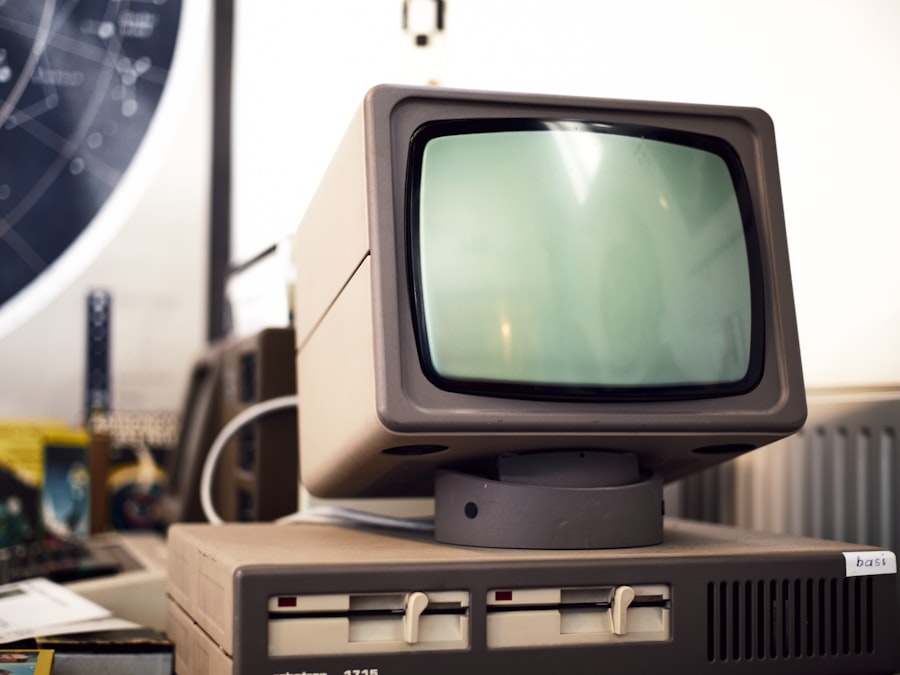
Before flat panels, computers showed their text as light from a phosphor coating struck by electrons. The colour of that light depended on which compound coated the inside of the glass. Pick the right one and you got amber: a warm glow I have never quite seen a flat panel match.
How a phosphor CRT actually works
Inside a CRT is an electron gun: a heated cathode that gives off electrons into a vacuum. Magnetic coils deflect the beam across the screen line by line, redrawing the picture 50 or 60 times a second. Where the beam strikes the coating on the inside of the glass, a phosphor turns that energy into visible light, a process called cathodoluminescence.
The compound sets the colour. Green screens used P1 or P39 (zinc orthosilicate with manganese) or P31 (zinc sulphide with copper). P3, a zinc beryllium silicate with manganese (Zn₈BeSi₅O₁₉:Mn), gives off an amber-yellow light that peaks at about 602 nanometres. Amber was widely held to be easier on the eyes than green.
A phosphor keeps glowing for a moment after the beam has passed. This persistence differs by compound: P31 fades in under a millisecond, while P3 is listed as medium persistence, about 13 milliseconds.
Simplified cross-section of a monochrome CRT. The electron gun fires a beam deflected by magnetic coils; where it strikes the phosphor layer, light is emitted.
By the mid-1980s many office workers spent the whole working day reading text on a monochrome screen. The glass was curved and caught the room's reflections, and each line glowed for a moment after it scrolled away.
The phosphor palette
Amber was one of several choices. Each phosphor had its own colour and afterglow, and buyers chose between them.
The classic green screen. P39 adds arsenic for a longer afterglow. The IBM 5151, the monitor sold with the IBM PC in 1981, used P39.
The phosphor of amber monochrome monitors, common beside green ones in the early and mid 1980s. The 12-inch USI Pi3 (1982), often paired with the Apple II and its clones, is a well-known example. Amber Theme's dark profile takes its look from this glow.
The phosphor of black-and-white television, used for white monochrome screens too. DEC's VT100 terminal (1978) had a white P4 screen; its VT220 (1983) came with white, green or amber tubes.
A yellowish green used in oscilloscopes and monochrome monitors. Its afterglow is very short, under a millisecond.
A brief chronology
- 1971IBM 3270 terminalIBM's mainframe terminal arrives. Its green text gives terminals of this kind their nickname: green screens.
- 1977Apple II launchesIts composite video output works with a television or a separate monitor.
- 1981IBM PCIBM's personal computer ships with the 5151 monitor: green P39 phosphor, 80 × 25 text at 50 Hz.
- 1982Amber on the deskAmber monitors such as the 12-inch USI Pi3 sell alongside green ones.
- 1986–1987Portable amberOrange and amber gas-plasma screens appear in portables: the Toshiba “T3100” (1986) and the Compaq Portable III (1987).
- 1987VGA arrivesIBM's VGA comes with the PS/2 line on 2 April 1987 and shows up to 256 colours at once.
- 1990MPR II and the EU directiveSweden's SWEDAC publishes MPR II, recommended limits for the electric and magnetic fields a monitor gives off. The same year the EU adopts its directive on work with display screens.
- 1992TCO'92The Swedish union TCO's label halves the MPR II field limits and adds an energy-saving sleep mode and electrical safety requirements.
The radiation debate
As terminals spread through offices in the late 1970s and early 1980s, people worried about what the screens might be doing to the people in front of them. It was a fair question: these devices worked by firing electrons at glass.
What a CRT actually emits
- X-raysProduced inside the tube when electrons strike the screen; the thick glass faceplate absorbs most of them. The US Bureau of Radiological Health measured 125 terminals and in 1981 found every one within state, federal and international guidelines.
- VLF fields (2–400 kHz)From the horizontal deflection circuits that steer the electron beam across the screen line by line.
- ELF fields (5 Hz–2 kHz)From the power supply and the vertical scan circuits, close to the frequency of mains electricity.
- UltravioletGiven off by the phosphor. A 1981 NIOSH survey at three San Francisco companies found ultraviolet, X-ray, radio-frequency and visible radiation "either undetectable or well below current exposure standards."
- Infrared & visible lightAlso from the phosphor. The screen is, by design, a source of visible light.
The fear
Around 1980, clusters of miscarriages and birth defects among women who worked at terminals were reported in the United States and Canada, and made headlines. NIOSH investigated more than 40 reported clusters of reproductive problems over the following decade. Most turned out not to be a real excess, and where one was, no cause could be found. NIOSH also pointed out that among millions of terminal users, some groups would show twice the usual miscarriage rate by chance alone.
Larger studies followed. A 1988 study of 1,583 pregnant women in Northern California found a higher miscarriage risk among those using terminals more than 20 hours a week, but other studies did not repeat the finding. A 1991 NIOSH study of telephone operators found no excess risk among terminal users, and a 1994 review concluded that terminal operators were not at greater risk than the general population.
The legacy that actually mattered
The debate found no radiation harm, but it changed the workplace. Sweden produced MPR II (1990) andTCO'92, voluntary limits on the fields a monitor gives off; TCO'95 added requirements for image quality. The EU's 1990 directive on display screen work told employers to plan breaks or changes of activity and offer eye tests, and asked for screens that tilt and swivel, without glare or flicker.
Much of today's advice on screen work, from regular breaks to eye tests, goes back to that decade of worry.